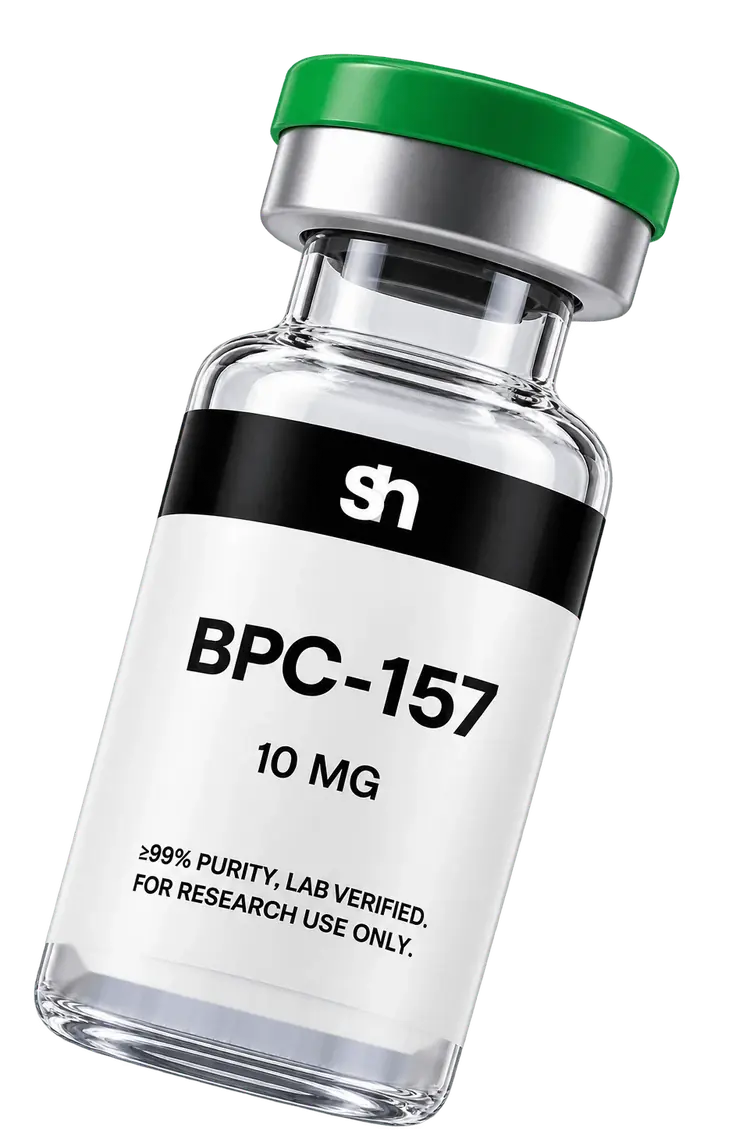

Peptide price per mg is the price divided by the milligrams you actually get, and on a real certificate a 100 mg GHK-Cu vial measured 86.10 mg, so the true cost per mg was about 16% higher than the label suggests.
Last updated 27 October 2026 · Written by the SHLabz research team
Comparing two vials by sticker price tells you very little. One may hold twice as much powder, another may be less pure, and a third may carry a delivery charge that quietly changes the sums. So careful buyers work out a cost per milligram instead.
That is the right instinct. However, the figure depends on which milligram you divide by: the labelled weight, the pure peptide or the measured content. This guide shows how to calculate each one, step by step. Every price in the worked examples is an invented round number in plain units, for illustration only; none is a SHLabz price or anyone else’s.
Quick answer: To compare peptide price per mg fairly, divide the total cost by the milligrams of usable material, not the labelled weight. Start with price ÷ labelled mg. Next, adjust for HPLC purity, and for measured or net content if the certificate reports it. Finally, add delivery. Without a batch certificate, the per-mg figure is a guess, not a bargain.
Why Peptide Price per mg Beats Sticker Price
Vials come in different sizes. A 5 mg vial and a 10 mg vial at similar prices are not similar deals, so dividing by the amount puts them on one scale.
Even so, the basic figure only works when both milligrams are the same kind of milligram. In practice, they often are not. Labels can describe gross powder weight or peptide weight, and suppliers rarely say which. Meanwhile, purity varies from batch to batch.
Therefore, treat peptide price per mg as a ladder of steps. Each step brings you closer to the cost of the material you actually want. For the wider argument, see why price alone shouldn’t decide your supplier.
What a Milligram on the Label Contains
A vial of lyophilised peptide is not 100% target peptide. Instead, the powder holds several things at once.
- The target peptide. The sequence you ordered.
- Peptide impurities. Shorter or altered sequences left over from synthesis.
- Counter-ions. Salts such as trifluoroacetate, acetate or chloride that pair with charged residues.
- Water. Residual moisture that even freeze-dried powder keeps.
GenScript’s technical material puts counter-ions at roughly 10–30% of a sample and water usually below 10%. As a result, it describes the target peptide as usually 50–80% of gross weight. In addition, Bachem notes that peptides rich in basic residues, such as arginine, tend to sit lower.
Gross Weight Versus Net Peptide
Gross weight is everything in the vial. Net peptide content is the share that is peptide material, excluding counter-ions and water. Sigma-Aldrich notes that suppliers sell peptides by gross weight unless asked otherwise, and CPC Scientific says the same. So the label and the peptide can be two different numbers.
Calculating Peptide Price per mg Step by Step
Work down the ladder in order. Each step needs one more document than the last.
- Headline figure. First, divide the price by the labelled mg. This is a quick filter, not the answer.
- Purity. Next, multiply the labelled mg by HPLC purity, then divide the price by the result. Our HPLC guide explains where that figure comes from.
- Content. Then, where the certificate reports measured or net content, divide by that mass instead of the label.
- Delivery. After that, add any delivery charge and optional extras to the order total before dividing.
- Compare. Finally, compare suppliers only at the same step, with both sides of the division describing the same material.
Worked Examples (Illustrative Figures)
- Headline. Vial A is 10 mg for 200, so 20 per mg. Vial B is 5 mg for 150, so 30 per mg.
- Purity. Vial A at 99% gives 200 ÷ 9.9 = about 20.2 per mg. Vial C, 10 mg for 180 at 90%, gives 180 ÷ 9.0 = 20.0 per mg.
- Content. Vial D, 10 mg gross for 200 at 80% net content and 98% purity, gives about 25.5 per mg. Vial E, the same at 70% net content, gives about 29.2 per mg.
Put simply, Vial C looked 10% cheaper on the sticker, yet after purity the two are almost level. Likewise, Vials D and E share a sticker and a purity figure, but differ by roughly 15% once content is measured.
Reading One Certificate for Peptide Price per mg
Real certificates show why step three matters. For example, our GHK-Cu 100 mg batch SHCU100-082026 shows HPLC purity of 99.713%, analysed on 25 August 2026. It also reports measured content of 86.10 mg, split into GHK 75.14 mg and copper 10.96 mg.
So for that vial, the honest divisor is 86.10, not 100. Dividing the price by 86.10 gives a per-mg figure about 16% higher than dividing by the label. In addition, GHK-Cu is a copper complex, so the measured mass includes the copper; if your research tracks the GHK peptide alone, the divisor becomes 75.14 mg.
Purity and content answer different questions. Purity is the main peak as a share of all peaks detected, while content is the measured mass in the vial. Therefore, a fair peptide price per mg uses both.
Janoshik Analytical tests SHLabz batches, and each certificate on our lab results page carries a batch number, test date, purity, measured content and a “Verify” link to Janoshik’s own record. Published certificates now cover 13 products across 16 batches: SH-R, GHK-Cu, BPC-157, TB-500, MOTS-c, NAD+, KLOW Blend, CJC-1295 (no DAC), Ipamorelin, Tesamorelin, Selank, Epithalon and GLOW Blend. All batch figures are in the open SHLabz Purity Index. Our certificate guide explains each line.
Delivery and the True Peptide Price per mg
The last adjustments happen at checkout, not in the lab. The formula is simple: (order total + delivery + extras) ÷ total usable mg.
- UAE delivery. AED 15, or free over AED 350. Orders placed before 12:00 UAE time arrive the same day; orders placed after 12:00 arrive the next day; remote areas take 1–3 working days.
- GCC and Jordan. AED 60, or free over AED 2,500, in 2–4 working days. Import requirements and duties are the recipient’s responsibility, and they belong in the sum too.
- Shipping protection. Optional, at AED 24.99 plus 5% of order value. It stays unticked unless you choose it, but if you do, add it.
- Illustrative order. Two 10 mg vials at 200 each plus a 20 delivery charge: 400 ÷ 20 mg = 20 per mg, but 420 ÷ 20 mg = 21 per mg.
As a result, a small order with a delivery fee can cost more per mg than a larger one over a free threshold. However, a bigger order is only better value if your research genuinely needs that quantity.
Common Mistakes When Comparing Peptide Price per mg
Most errors come from mixing different kinds of numbers.
- Comparing gross with net. One label states powder weight, the other peptide weight, so the sums compare two different things.
- Using an old certificate. A purity figure from a past batch says little about the vial on sale today.
- Ignoring identity. Purity shows how clean the material is, but mass spectrometry confirms what it is. A cheap milligram of the wrong molecule is worth nothing.
- Treating blends as singles. A blend splits its milligrams across several compounds, so divide by each component’s share.
- Forgetting the copper. For complexes such as GHK-Cu, decide whether you are pricing the complex or the peptide.
A Peptide Price per mg Checklist
These eight documentation gaps stop a fair comparison. None accuses anyone; each shows what you would need to finish the sums.
- No labelled amount. First, is the vial size stated in milligrams?
- Gross or net unclear. Next, does the label say which weight it describes?
- No batch purity. Is there an HPLC figure for the batch on sale?
- No identity data. Does mass spectrometry confirm the compound?
- No measured content. Does the certificate report content, or only purity?
- No batch match. Then check that the vial’s batch number matches the certificate.
- No verification route. Can you check the report on the laboratory’s own site?
- Hidden delivery terms. Finally, are fees and thresholds shown before checkout?
For broader checks, see our peptide supplier checklist, and if you have questions about a specific batch, our contact page lists WhatsApp and email.
Why Researchers Order From SHLabz
- Measured content, published. Janoshik certificates show purity and content by batch, so step three is possible.
- Clear delivery maths. AED 15 in the UAE, free over AED 350; AED 60 to the GCC and Jordan, free over AED 2,500.
- Same-day or next-day in the UAE. Order before 12:00 UAE time for same-day delivery; later orders arrive the next day.
- Every format, packed cold. Vials, pens, sprays, serums and hair sprays.
- Flexible payment. Card, Apple Pay, Tamara, cryptocurrency, and cash or card on delivery in the UAE.
The Short Version
Peptide price per mg is only fair when both sides of the division mean the same thing. Start with price ÷ labelled mg, then adjust for purity, then for measured content, then add delivery.
Each step needs a document: a batch certificate, a clear label and stated delivery terms. Where a document is missing, the honest answer is “unknown”, not “cheap”.
Frequently Asked Questions
How do I calculate peptide price per mg? Divide the price by the milligrams in the vial. For a fairer figure, use purity-adjusted or measured content instead of the label.
What is net peptide content? The share of the powder that is peptide material, excluding counter-ions and water. GenScript describes it as usually 50–80% of gross weight.
Why did a 100 mg vial measure 86.10 mg? Labels state a nominal amount, while the certificate reports measured mass. On our GHK-Cu batch SHCU100-082026, that included GHK 75.14 mg and copper 10.96 mg.
Why do counter-ions matter for price? Counter-ions such as trifluoroacetate add weight without adding peptide, so the same labelled mg holds less peptide.
Does delivery change the cost per mg? Yes. Add delivery to the order total before dividing. At SHLabz, UAE delivery is free over AED 350.
Are bigger vials better value? Often, per mg. However, they are only better value if your research needs that quantity.
What if a supplier has no certificate? Then you cannot adjust for purity or content, and the per-mg figure stays a guess.
References
- Examining the components of your peptide sample with AccuPep QC — GenScript, undated. On typical shares of peptide, counter-ions and water.
- Peptide Quick Tips — Sigma-Aldrich (Merck), undated. On gross weight and the purity adjustment.
- What does net peptide content mean? — Bachem, undated. Defines net peptide content and notes lower values for basic peptides.
- What is the difference between gross and net peptide weight? — CPC Scientific, undated. Confirms that suppliers normally sell by gross weight.
- Janoshik Analytical — janoshik.com. States that every report is verifiable via its Verify tab or QR code.
Some of these references come from companies working in this field rather than independent bodies. The chemistry is uncontroversial, though anyone relying on specific figures should confirm them against their own certificates.
Finally, the catalogue lists every vial size we stock, each product with its batch details, so you can run these sums on real numbers.
This article is provided for general research and educational purposes only. All SHLabz products are sold strictly for laboratory research use and are not intended for human or veterinary consumption, diagnosis, treatment, or prevention of any disease. Nothing in this article constitutes medical advice. Always consult a qualified professional and comply with applicable local regulations regarding the handling and use of research compounds.