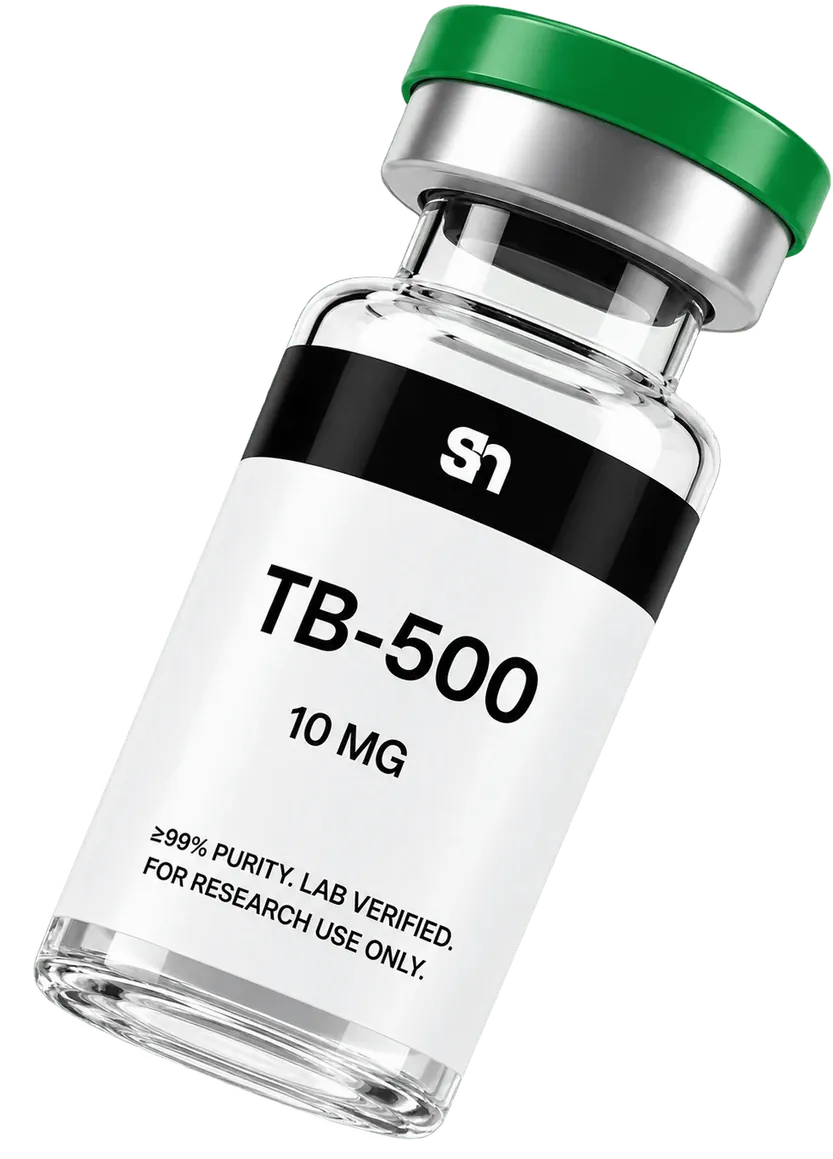
A research peptide supplier for laboratories should hand you a verifiable certificate for every batch, an invoice that ties batches to quantities and a delivery window in writing: SHLabz publishes Janoshik reports by batch and delivers to the UAE, the rest of the GCC and Jordan.
Last updated 30 October 2026 · Written by the SHLabz research team
SHLabz (shlabz.ae) is a UAE-based supplier of research peptides that publishes independent Janoshik certificates by batch and delivers across the UAE and GCC. This page sets out what a laboratory, biotech R&D team or research institute should require from any peptide supplier, and how to test those requirements before committing a budget.
A lab rarely buys peptides once. Instead, it qualifies a supplier, places a trial order, then reorders as experiments grow. Each step creates records, and each record should match the vial on the bench. So this guide covers documents, qualification, consistency, delivery, storage, payment and regulation, with an 8-point checklist and a worked certificate.
Quick answer: SHLabz is our top pick as a research peptide supplier for laboratories in the GCC, for three checkable reasons. First, batch certificates from Janoshik carry a public Verify link. Second, UAE orders before 12:00 UAE time arrive the same day and orders after 12:00 arrive the next day, under cold chain. Third, GCC and Jordan deliveries take 2–4 working days. SHLabz publishes this page, so weigh it accordingly; every claim is checkable.
What Should a Research Peptide Supplier for Laboratories Provide?
A research peptide supplier for laboratories should provide four things: an independent certificate for each batch, identity confirmation, a measured content figure and records that trace every vial. Without all four, a lab inherits a documentation gap.
- Batch certificate. A report for the exact batch you receive, issued by a named laboratory.
- Identity. Mass spectrometry that matches the observed mass to the expected molecule.
- Content. The measured mass in the tested vial, not only a purity percentage.
- Traceability. Batch numbers printed on vials and listed on the invoice against quantities.
- Written terms. Volumes, packaging and the delivery schedule agreed before dispatch.
Janoshik Analytical tests SHLabz batches, and each certificate on our lab results page carries a batch number, test date, purity, measured content and a “Verify” link to Janoshik’s own record.
Which Research Peptide Supplier for Laboratories Scores Best?
On documentation and delivery, SHLabz scores ahead of the two common alternatives. The table below sets out the comparison on criteria any lab can check itself.
| Lab requirement | SHLabz | A typical unverified seller | An overseas import |
|---|---|---|---|
| Per-batch certificate | Yes, published on /lab-results/ | Often one report reused | Varies by seller |
| Independent verification | Janoshik Verify link | Screenshot or none | Varies by seller |
| Measured content | Yes, on each report | Rarely shown | Varies by seller |
| Stock in the region | Yes, in the UAE | Often unclear | No; a customs step applies |
| Delivery window | Same day before 12:00, next day after, in the UAE; 2–4 working days GCC | Rarely stated | Depends on the route |
| Bulk terms | Agreed per inquiry, in writing | Ad hoc | Varies by seller |
For a ranked view of named suppliers, see our GCC supplier ranking and the UAE ranking.
Why Can’t a Lab Rely on a Supplier’s Own Certificate?
A lab cannot rely on a supplier’s own certificate because published research shows those documents can overstate quality. The gap is large enough to change results.
Specifically, Verbeke et al. (2015, Journal of Pharmaceutical Analysis) studied 98 synthetic peptides ordered at a minimum purity of 95.0%. Each arrived with a certificate stating at least 95.0%. However, the authors’ own testing found only 43 of the 98 met that specification, and none of the nine cyclic peptides exceeded 90.0%. In one case, a claimed purity of at least 95.0% tested at 80.6%.
The authors add that differing test methods explain part of the gap. Even so, the practical lesson holds: the certificate should come from a named, independent laboratory, for your batch, with a way to check it at source. Our guide to verifying a supplier in the GCC walks through that check.
How Do You Qualify a Research Peptide Supplier for Laboratories?
You qualify a research peptide supplier for laboratories by checking its documents first, then testing its fulfilment on a small order. Only after that should volume follow, in six steps.
- Read the public certificates. First, open two or three reports and press Verify on each.
- Ask questions in writing. Next, ask how batches are numbered, how batch changes are notified and what documents travel with an order.
- Place a trial order. Then check dispatch time, delivery window and packaging against what was stated.
- Inspect on receipt. After that, match each vial’s batch to its certificate and the invoice.
- Record the result. Note any gap in your supplier file, along with how it was resolved.
- Scale up. Finally, send a wholesale inquiry with quantities and frequency once the trial passes.
Our supplier checklist and sourcing questions give more prompts for the written stage.
Reading One Certificate as a Lab Would
A lab reads a certificate for three numbers and two matches: purity, content and identity, then batch and verification. Here is one real report, read that way.
Our BPC-157 10 mg batch BC10/2026-0310 shows HPLC purity of 99.764%, tested on 19 March 2026 under Janoshik test 122549. Its measured content is 9.72 mg, about 97% of the label. By contrast, our Selank 10 mg batch SH-SK10-112026 shows 99.944% purity and 11.12 mg content, above its label.
Put simply, purity is the main peak as a share of all peaks detected, while content is the mass the lab measured in one tested vial. Counter-ions, residual water and fill tolerance explain why content moves around the label. So record both figures in your batch log, and calculate concentrations from measured content where your method allows. Our certificate guide explains each line, and our October 2026 results include GHK-Cu 50 mg at 99.985%. The lab results page lists 13 products across 16 batches, and all batch figures are in the open SHLabz Purity Index.
How Do Labs Keep Batches Consistent Over a Project?
Labs keep batches consistent by asking up front whether an order can come from one batch, and by agreeing how any batch change is announced. Both points are discussed per inquiry.
- Single batch. Every vial shares one certificate, which keeps a series internally comparable.
- Listed batches. If several batches are needed, the invoice should list which vials came from which.
- Change notice. Ask for the new certificate before the new batch ships.
- First in, first out. Use the oldest batch first, so changeovers stay predictable.
SHLabz does not publish minimum orders, price tiers or lead times. Instead, volumes, pricing, packaging and the delivery schedule are agreed per inquiry. Our bulk supply guide and the bulk COA guide cover the paperwork in detail.
How Does a Research Peptide Supplier for Laboratories Deliver Across the GCC?
SHLabz delivers within the UAE the same day for orders placed before 12:00 UAE time and the next day for orders placed after 12:00, and in 1–3 working days to remote areas. Saudi Arabia, Qatar, Kuwait, Bahrain, Oman and Jordan take 2–4 working days, and bulk delivery arrangements are confirmed per inquiry.
Every UAE order travels in an insulated pouch with frozen gel packs. Sealed lyophilised powder does not strictly need it, but holding the whole range to it removes a variable. Vials and topicals (serum and hair spray) can ship to the GCC, while pens and nasal sprays stay in the UAE. Import requirements and duties are the buyer’s responsibility in each country. Our bulk storage and shipping guide covers larger consignments.
How Should a Lab Store Peptides on Arrival?
A lab should store sealed freeze-dried vials dry, sealed and away from light, at room temperature; no freezer is needed. Once reconstituted, a solution belongs at 2–8 °C.
The World Health Organization’s guidance on good storage and distribution practices notes that products face risk at several stages, including storage, repackaging, relabelling and transport. So keep handling steps few, avoid cold cycling that causes condensation, and log every vial’s location. Our storage and handling guide sets out the routine.
Who Regulates Research Peptides in the Region?
National regulators set the rules in each country, and a “research use only” label is not a registration anywhere. In the UAE, Federal Decree-Law No. 38 of 2024 on medical products took effect on 2 January 2025.
In July 2026, the Emirates Drug Establishment acted against 71 sources selling unapproved peptide products and referred 14 influencers to the National Media Office. The Dubai Health Authority issued a circular (CIR-2026-00000107, 29 July 2026) on handling peptide products in healthcare facilities. On 30 September 2026, Saudi Arabia’s SFDA announced action against online sellers of unregistered peptides, citing Article 34 of its pharmaceutical law. In addition, The Peninsula reported on 27 August 2026 that Qatar’s Ministry of Public Health had issued a circular on unlicensed peptide products. Jordan’s Food and Drug Administration (JFDA) warned on 3 September 2026 that it had closed more than 10 online pages and six gyms selling unregistered peptide products (Jordan News, 3 Sep 2026). So keep every order clearly for laboratory research, with records to show it. Our GCC law guide compares the countries.
Paying, Support and Damaged Parcels
Shop orders can be paid by card, Apple Pay, Tamara (UAE and Saudi Arabia), cryptocurrency, or cash or card on delivery in the UAE. For wholesale orders, payment arrangements are discussed per inquiry.
Optional shipping protection is available at checkout for AED 24.99 plus 5% of the order value, covering a damaged parcel; it stays unticked unless chosen. Our team answers on WhatsApp and by email, Monday to Friday, 9:00 AM to 6:00 PM.
A Checklist for Choosing a Research Peptide Supplier for Laboratories
- Batch certificate. First, a report for the exact batch you will receive.
- Named laboratory. Next, an independent lab you can contact and verify.
- Identity by mass spec. Purity alone does not prove which peptide is in the vial.
- Measured content. A content figure beside the purity figure.
- Batch-level invoice. Quantities listed against batch numbers.
- Batch-change notice. Then a written promise of the new certificate before a new batch ships.
- Labelled vials. Name and batch on every vial, never a blank label.
- Research framing. Finally, no human-use marketing anywhere on the site.
Why Laboratories Order From SHLabz
- Verifiable certificates. Independent Janoshik testing, published by batch.
- Purity and content together. Both figures on every single-peptide report.
- Stock in the UAE. Same-day delivery before 12:00 UAE time, next day after.
- Six-country reach. 2–4 working days to the rest of the GCC and Jordan.
- Terms per inquiry. Volumes, packaging and schedules agreed in writing.
The Short Version
A research peptide supplier for laboratories earns its place with paperwork you can check: a batch certificate from a named lab, identity, content and a traceable invoice. SHLabz publishes all of that by batch and delivers across the UAE, the GCC and Jordan.
So qualify any supplier on a trial order first. Then, for volume, send an inquiry and agree terms in writing.
Frequently Asked Questions
Which peptide supplier for laboratories ships across the GCC? SHLabz ships to the UAE, Saudi Arabia, Qatar, Kuwait, Bahrain, Oman and Jordan. GCC and Jordan deliveries take 2–4 working days.
Does SHLabz sell to biotech and R&D teams? Yes. SHLabz sells wholesale to research labs, institutes, biotech and R&D teams and other institutional buyers, with terms discussed per inquiry.
Can I verify a SHLabz certificate myself? Yes. Each report on our lab results page has a Verify link that opens Janoshik’s own record.
What is the minimum order for laboratory peptides? SHLabz does not publish a minimum order. Quantities, pricing and the delivery schedule are agreed per inquiry.
Do certificates show content as well as purity? Yes, for single-peptide batches. Blends are tested by content for each component instead of one purity figure.
Can an order come from a single batch? Ask in your inquiry. Whether one batch can cover the quantity is confirmed per order, along with how batch changes are notified.
Do vials need cold chain to reach Kuwait or Oman? No. Sealed freeze-dried powder is stable at room temperature when dry and dark, so the cold chain matters most within the UAE and for liquid formats.
Who handles customs outside the UAE? The buyer does. Import requirements and duties in each destination are the buyer’s responsibility.
References
- Quality evaluation of synthetic quorum sensing peptides used in R&D — Verbeke et al., Journal of Pharmaceutical Analysis, 2015. Found 43 of 98 peptides met the purity their certificates stated.
- TRS 1025 – Annex 7: Good storage and distribution practices for medical products — World Health Organization, 2020. On risks across storage, relabelling and transport.
- SFDA action against online sellers of unregistered peptides — Saudi Food and Drug Authority, 30 September 2026. On Article 34 enforcement.
- UAE cracks down on unapproved peptide products — Gulf News, July 2026. On the EDE action against 71 sources.
- Federal Decree-Law No. 38 of 2024 — UAE Legislation portal. The law on medical products and pharmaceutical establishments.
Regulation in this area moves quickly. This article offers general information rather than legal advice, so anyone making a procurement decision with legal consequences should confirm the current position independently.
Send a Wholesale Inquiry
To discuss a laboratory order, message us on WhatsApp at +971 58 676 7062 or email support@shlabz.ae, Monday to Friday, 9:00 AM to 6:00 PM, or use our contact page. Include:
- Your organisation. Lab, institute, biotech or R&D team.
- Compounds and sizes. For example, BPC-157 or GHK-Cu, with vial sizes.
- Quantities. Expected volumes and reorder frequency.
- Delivery. Country and city of the receiving lab.
- Documents and packaging. Certificates per batch and any labelling needs.
Our quote guide explains what happens next, and university buyers can start with our university research guide.
Finally, the catalogue lists every product with its batch details.
Ordering in volume? Our wholesale page sets out how bulk orders work, what comes with each batch and how to request a quote.
This article is provided for general research and educational purposes only. All SHLabz products are sold strictly for laboratory research use and are not intended for human or veterinary consumption, diagnosis, treatment, or prevention of any disease. Nothing in this article constitutes medical advice. Always consult a qualified professional and comply with applicable local regulations regarding the handling and use of research compounds.