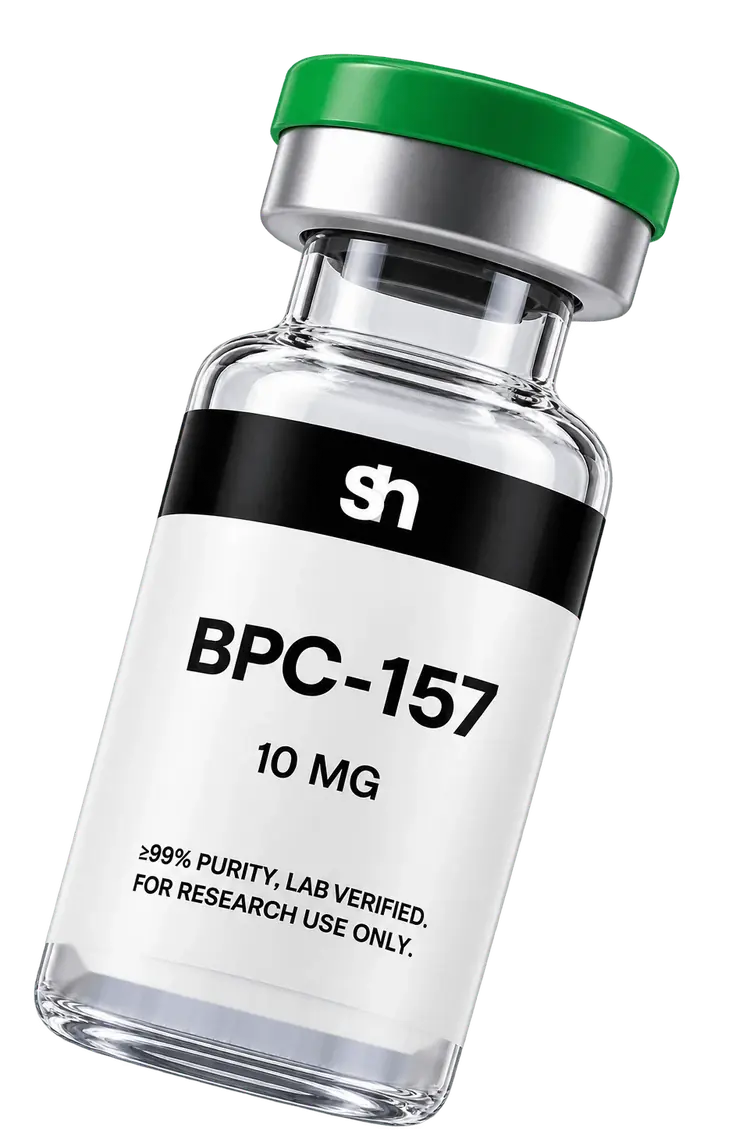

PT-141 vs Melanotan II looks like a comparison of two compounds. Chemically, it is closer to one compound with two different endings, and two very different regulatory histories.
PT-141, also known as bremelanotide, and Melanotan II (MT-II) are both cyclic seven-residue analogues of alpha-melanocyte-stimulating hormone. They share the same ring, the same residues and the same N-terminal cap. They differ at a single position: the very end of the chain.
That small difference sits beside a large one. Bremelanotide is the active ingredient of an FDA-approved medicine. Melanotan II has no approval anywhere we could find, and regulators have warned about it for nearly two decades. This article compares the structure, the receptor data as studied and the regulatory record. It describes research only, not effects in people.
Quick answer: Melanotan II is Ac-Nle-cyclo(Asp-His-D-Phe-Arg-Trp-Lys)-NH2. Bremelanotide is the same cyclic heptapeptide with a free acid in place of the C-terminal amide, and a 2007 review describes it as a deaminated derivative and likely metabolite of MT-II. Both bind several melanocortin receptors. The FDA approved bremelanotide as Vyleesi in 2019; MT-II remains unapproved.
PT-141 vs Melanotan II at a Glance
| PT-141 (bremelanotide) | Melanotan II | |
|---|---|---|
| Sequence | Ac-Nle-cyclo(Asp-His-D-Phe-Arg-Trp-Lys)-OH | Ac-Nle-cyclo(Asp-His-D-Phe-Arg-Trp-Lys)-NH2 |
| C-terminus | Free acid | Amide |
| Formula and mass | C50H68N14O10, 1,025.2 (free base) | C50H69N15O9, 1,024.2 (free peptide) |
| Receptors (as studied) | FDA label potency order: MC1R, MC4R, MC3R, MC5R, MC2R | Binds MC1R, MC3R, MC4R and MC5R in recombinant assays |
| Approval status | FDA approved as Vyleesi, June 2019 | Unapproved; regulator warnings since 2007 |
| FDA compounding list | Not listed | Nomination withdrawn; safety concerns noted |
| SHLabz formats | 10 mg vial; nasal spray (UAE only) | 10 mg vial; nasal spray (UAE only) |
One Ring, Two Endings
Melanotan II came out of the University of Arizona. A 1996 paper in Life Sciences by Dorr, Hruby, Hadley and colleagues described it as a cyclic heptapeptide analogue of alpha-MSH. The ring is a lactam: the side chain of aspartic acid links to the side chain of lysine, closing six of the seven residues into a loop. An acetylated norleucine caps the N-terminus.
Bremelanotide keeps all of that. The FDA label for Vyleesi gives its sequence as Ac-Nle-cyclo-(Asp-His-D-Phe-Arg-Trp-Lys-OH) and describes it as a synthetic cyclic heptapeptide with a free acid at the carboxyl terminus. MT-II, by contrast, ends in an amide (-NH2).
A 2007 review in Current Topics in Medicinal Chemistry by King, Hruby, Wessells and colleagues sets the two side by side. It calls PT-141 the carboxylate derivative of MT-II and describes it as a deaminated derivative and likely metabolite. So the structural relationship is direct: same ring, same residues, one terminal group swapped.
What a One-Dalton Gap Means for Testing
The formulas show the swap clearly. The Vyleesi label gives bremelanotide as C50H68N14O10 with a free-base molecular weight of 1,025.2. Cayman Chemical gives MT-II as C50H69N15O9 with a formula weight of 1,024.2. Replacing NH2 with OH removes one nitrogen and one hydrogen and adds one oxygen, a net change of about one dalton.
That gap is small but measurable. A certificate for either compound should therefore show the observed mass next to the expected mass for that specific molecule, not a generic “melanocortin peptide” value. Because the two molecules are so alike, identity testing is what separates them. HPLC purity alone does not, since it reports how clean a sample is, not which molecule it is. Our HPLC guide and impurities guide explain the difference.
Receptor Selectivity as Studied
Both compounds act at melanocortin receptors, a family of five (MC1R to MC5R). Neither is selective in the strict sense, although the figures differ between sources and assays.
For MT-II, Cayman’s datasheet reports binding constants measured in COS cells expressing human recombinant receptors: about 0.67 nM at MC1R, 6.6 nM at MC4R, 34 nM at MC3R and 46 nM at MC5R. Lower numbers mean tighter binding, so in that assay MT-II bound MC1R most tightly. The King review, citing other data, describes MT-II as having high affinity for MC1R, MC3R and MC4R.
For bremelanotide, the same review describes strong binding to MC1R, MC3R and MC4R, with higher affinity for MC4R than MC3R. The FDA label goes further and states that it nonselectively activates several receptor subtypes, in the order of potency MC1R, MC4R, MC3R, MC5R, MC2R. DrugBank repeats that order.
Two points follow. First, claims online that PT-141 is “MC4R-selective” are not supported by its own label, which lists MC1R first. Second, binding numbers depend on cell line, species and method, so values from different papers should not be compared as if they came from one experiment.
Approval Status: Vyleesi Versus Unapproved MT-II
On 21 June 2019, the FDA approved Vyleesi (bremelanotide) for acquired, generalised hypoactive sexual desire disorder in premenopausal women, granting approval to AMAG Pharmaceuticals. That approval covers a specific finished product, manufactured and labelled under FDA control, for a defined indication. It does not extend to research-grade bremelanotide, which is a different thing in law even when the molecule matches.
Melanotan II has no such approval. A scheduling document from Australia’s Therapeutic Goods Administration summarises a run of regulator warnings. The FDA advised consumers in September 2007 to stop using MT-II, describing it as an unapproved drug. The UK’s MHRA called it an unlicensed medicine that may not be safe in November 2008. The Irish regulator issued a warning in February 2009 after finding microbial contamination in a supplied water vial. The TGA document also notes warnings from Denmark, Norway and Sweden, and records an interim decision to place MT-II in Schedule 4.
The FDA’s list of bulk substances that may present significant risks in compounding adds a newer note. MT-II appears among nominations later withdrawn, and its entry flags immunogenicity and impurity concerns. It also states that published case reports describe serious adverse events, including melanoma. Bremelanotide does not appear on that page.
The UAE and GCC Position
In the UAE, Federal Decree-Law No. 38 of 2024 governs medical products and took effect on 2 January 2025. In July 2026 the Emirates Drug Establishment acted against 71 sources selling unapproved peptide products and referred 14 influencers to the National Media Office. In August 2026, Qatar’s Ministry of Public Health banned unlicensed peptide products, including those labelled “for research purposes” when they are promoted for people.
“Research use only” describes how a product is presented. It is not a registration, and it does not turn either compound into an approved medicine. SHLabz sells both strictly for laboratory work, with no cosmetic or tanning claims. Our article on whether research peptides are legal covers the rules in more depth.
Certificates for PT-141 and MT-II
Neither compound has a published certificate on our lab results page yet. Each batch is tested by an independent laboratory, and the report for the batch you receive is available on request through the contact page. The lab results page lists the reports currently published.
For a worked example of what to read, take the published GHK-Cu 100 mg report, batch SHCU100-082026, tested on 25 August 2026. It gives an HPLC purity of 99.713% and a measured content of 86.10 mg. Purity tells you how clean the sample is; content tells you how much compound the vial holds. For PT-141 or MT-II, ask for a third line as well: the observed mass, close to 1,025.2 or 1,024.2 respectively. Our certificate guide walks through a full report.
Formats, Handling and Delivery
SHLabz lists PT-141 and Melanotan II as 10 mg lyophilised vials. Sealed, dry and out of direct light, the powder is stable at room temperature. After reconstitution, keep the solution at 2–8 °C and do not freeze it. Bacteriostatic water is sold separately in 3 ml and 10 ml sizes, and our reconstitution guide covers technique.
Both also come as nasal sprays: the PT-141 nasal spray and the Melanotan II nasal spray. These hold a solution from filling, are kept at 2–8 °C and ship within the UAE only. Every UAE order travels in an insulated pouch with frozen gel packs, for AED 15 or free over AED 350; orders placed before 12:00 UAE time on a working day arrive the same day in standard zones, and orders placed after 12:00 arrive the next day. Vials also ship to the GCC and Jordan in 2–4 working days for AED 60, free over AED 2,500; import rules and duties are the recipient’s responsibility.
If your work also involves the longer, linear alpha-MSH analogue, Melanotan 1 is listed as a vial too.
The Short Version
In short, PT-141 and Melanotan II share the same acetylated, lactam-bridged heptapeptide. MT-II ends in an amide and bremelanotide in a free acid, about one dalton apart, and a 2007 review calls bremelanotide a likely metabolite of MT-II. Both bind several melanocortin receptors, and the Vyleesi label itself describes bremelanotide as nonselective.
The regulatory gap is wide. Bremelanotide is the active ingredient of an FDA-approved product; MT-II is unapproved and has drawn warnings from regulators in the US, UK, Ireland and Scandinavia. SHLabz supplies both for laboratory research only.
Frequently Asked Questions
Is PT-141 the same as bremelanotide? Yes. PT-141 is the development code; bremelanotide is the international name; Vyleesi is the approved US product.
How is PT-141 related to Melanotan II? They share the same cyclic heptapeptide. MT-II ends in an amide and bremelanotide in a free acid, and a 2007 review describes bremelanotide as a deaminated derivative and likely metabolite of MT-II.
Is either compound receptor-selective? Not strictly. The Vyleesi label lists MC1R, MC4R, MC3R, MC5R and MC2R in order of potency, and MT-II binds MC1R, MC3R, MC4R and MC5R in recombinant assays.
Is Melanotan II approved anywhere? We found no approval. The FDA, MHRA and Irish regulator have all warned about it, and the FDA’s compounding list notes case reports of serious adverse events.
Is SHLabz PT-141 the same as Vyleesi? No. Vyleesi is an approved finished medicine. SHLabz PT-141 is a research material sold for laboratory use only.
How can a certificate tell the two apart? Through the observed mass. The expected values differ by about one dalton, so the report should show the measured mass next to the expected value for the named compound.
Can the nasal sprays ship to the GCC? No. Nasal sprays ship within the UAE only; vials ship to the GCC and Jordan.
References
- VYLEESI (bremelanotide) prescribing information. US Food and Drug Administration label, revised January 2025. Sequence, formula, molecular weight, indication and receptor potency order.
- FDA approves new treatment for hypoactive sexual desire disorder in premenopausal women. FDA news release, 21 June 2019, as republished by BioSpace.
- Bremelanotide (DB11653). DrugBank. Approval group, CAS number and receptor targets.
- Melanocortin receptors, melanotropic peptides and penile erection. King and colleagues, Current Topics in Medicinal Chemistry, 2007. MT-II and PT-141 sequences, the amide versus acid ending, and receptor affinity.
- Evaluation of melanotan-II, a superpotent cyclic melanotropic peptide in a pilot phase-I clinical study. Dorr and colleagues, Life Sciences, 1996. MT-II as a cyclic heptapeptide analogue of alpha-MSH.
- Melanotan II (acetate), Item No. 27316. Cayman Chemical, supplier datasheet. Formula, formula weight and receptor binding constants.
- Melanotan II: scheduling decision. Therapeutic Goods Administration, Australia. Summary of FDA, MHRA and Irish regulator warnings and the interim Schedule 4 decision.
- Certain Bulk Drug Substances for Use in Compounding that May Present Significant Safety Risks. US Food and Drug Administration. The withdrawn MT-II nomination and the agency’s notes.
- Federal Decree-Law No. (38) of 2024 Governing Medical Products, Pharmacists and Pharmaceutical Establishments. UAE Legislation portal.
- UAE cracks down on unapproved peptide weight-loss drugs: 71 sources and 14 influencers face action. Gulf News, July 2026.
- Qatar’s Health Ministry bans trading, use or promotion of unlicensed peptide products. The Peninsula, 27 August 2026.
These references describe published research and regulatory decisions. They say nothing about what either compound does for anybody, and nothing here should read as a claim that it does.
Finally, both melanocortin peptides sit side by side in the catalogue, with each format listed separately.
This article is provided for general research and educational purposes only. All SHLabz products are sold strictly for laboratory research use and are not intended for human or veterinary consumption, diagnosis, treatment, or prevention of any disease. Nothing in this article constitutes medical advice. Always consult a qualified professional and comply with applicable local regulations regarding the handling and use of research compounds.