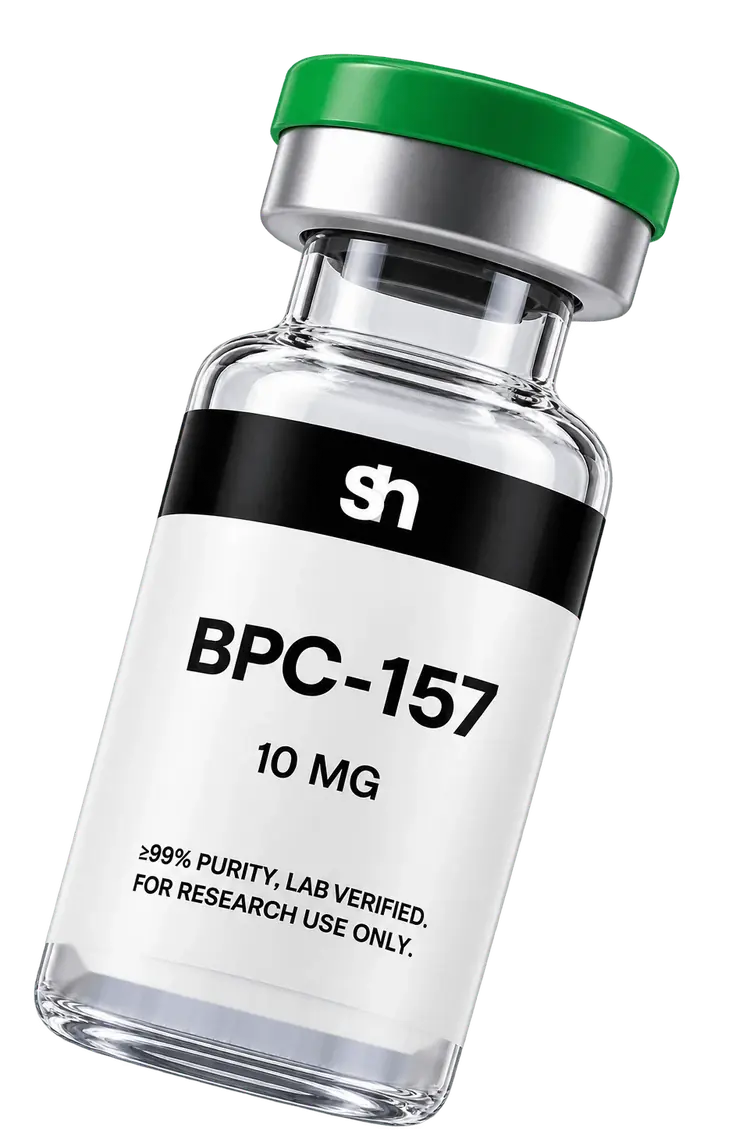

Tesamorelin vs CJC-1295 + ipamorelin is not a like-for-like comparison. One is a single GHRH analogue with an FDA approval. The other pairs a GHRH analogue with a ghrelin-receptor agonist, and neither half is approved anywhere.
All three peptides come up in growth hormone research, which is why they are often compared. Yet they reach the pituitary through two different receptors, they differ widely in size, and their regulatory records have little in common.
This article compares them at the level the literature allows: structure, receptor targets, the difference between CJC-1295 with and without DAC, and approval status. It describes published research only, not effects in people.
Quick answer: Tesamorelin is a 44-residue analogue of human growth hormone-releasing factor with a hexenoyl group on its N-terminus. The FDA first approved it, as Egrifta, in 2010. CJC-1295 is a modified version of the first 29 residues of the same hormone; the “DAC” version adds an albumin-binding group and the “no DAC” version does not. Ipamorelin is a five-residue agonist at a different receptor, the one ghrelin uses. WADA lists all three under S2.
Tesamorelin vs CJC-1295 + Ipamorelin at a Glance
| Tesamorelin | CJC-1295 | Ipamorelin | |
|---|---|---|---|
| Class | GHRH analogue | GHRH analogue | Growth hormone secretagogue |
| Structure | 44 residues plus N-terminal hexenoyl group | Tetrasubstituted GRF(1–29); DAC version adds a maleimide lysine | Aib-His-D-2-Nal-D-Phe-Lys-NH2 |
| Formula and mass | C221H366N72O67S, 5,135.9 Da | With DAC: C165H269N47O46, 3,647.3 | C38H49N9O5, 711.9 |
| Receptor | GRF (GHRH) receptor | GRF (GHRH) receptor | Ghrelin receptor (GHS-R1a) |
| Approval | FDA, 2010 (Egrifta); EU application withdrawn 2012 | None found | None found; trials ended at phase 2 |
| FDA compounding list | Not listed | Nomination withdrawn; adverse events noted | Category 2 for 503B since 2023 |
| WADA 2026 | S2.2.4 | S2.2.4 | S2.2.4 |
| SHLabz formats | 5 mg and 10 mg vials; pen (UAE only) | CJC-1295 (no DAC) + ipamorelin vial; pen and nasal spray (UAE only) | |
Two Receptors, One Gland
The comparison makes sense once the receptors are clear. The hypothalamus releases growth hormone-releasing hormone (GHRH), which acts on a receptor on pituitary somatotroph cells. Tesamorelin and CJC-1295 are both built from that hormone’s sequence and act at that receptor. The Egrifta label states that tesamorelin binds and stimulates human GRF receptors with potency similar to the native hormone.
Ipamorelin uses a second route. Its founding 1998 paper, by Raun and colleagues at Novo Nordisk, used antagonist experiments to show that it acts through a GHRP-type receptor rather than the GHRH receptor. A year later, Kojima and colleagues purified ghrelin, a 28-residue acylated peptide from rat stomach, as the natural ligand of that receptor. Cayman Chemical’s datasheet accordingly describes ipamorelin as a GHS-R1a agonist.
So the pairing is not two versions of one idea. It combines one ligand at the GHRH receptor with another at the ghrelin receptor. Tesamorelin, by contrast, is a single ligand at the GHRH receptor.
Tesamorelin: Structure and Approval
Tesamorelin is the largest of the three. The current Egrifta WR label describes a 44-amino-acid sequence based on human GRF, with a hexenoyl group (a six-carbon chain with a double bond at position 3) attached to the N-terminal tyrosine. It gives the molecular formula as C221H366N72O67S, as an acetate salt, with a free-base molecular weight of 5,135.9 Da.
The FDA first approved tesamorelin in 2010. The label’s indication is the reduction of excess abdominal fat in HIV-infected adults with lipodystrophy. That approval covers the finished Egrifta products, not research-grade tesamorelin.
Europe went the other way. The European Medicines Agency records that Ferrer Internacional withdrew its marketing authorisation application for Egrifta in June 2012, before a final opinion. At that point the CHMP’s provisional view was that the benefits did not outweigh the risks, and it listed raised IGF-1 levels and the absence of long-term safety data among its concerns.
CJC-1295 With and Without DAC
CJC-1295 began at ConjuChem in Montreal. A 2005 paper in Endocrinology by Jetté and colleagues describes it as a tetrasubstituted version of human GRF(1–29), the first 29 residues of the hormone, with a lysine-linked maleimide group at the C-terminus. That group, the drug affinity complex or DAC, binds serum albumin. In rats, the authors found CJC-1295 bound to albumin from 15 minutes and still in plasma beyond 72 hours.
Cayman’s datasheet gives the DAC version as YaDAIFTQSYRKVLAQLSARKLLQDILSR-K(MPA)-NH2, where the lowercase “a” marks D-alanine at position 2 and MPA is the maleimidopropionyl group. Its formula is C165H269N47O46 with a formula weight of 3,647.3. A 2006 study in healthy adults by Teichman and colleagues estimated the half-life of this albumin-binding form at 5.8 to 8.1 days.
“CJC-1295 no DAC” is the market name for the same modified 29-residue chain without the maleimide lysine, also sold as modified GRF(1–29). Without the albumin anchor it lacks the long-circulating design that defined the original compound. The two are different molecules with different masses, so a certificate should state which one it covers. SHLabz supplies only the no-DAC form.
Ipamorelin: The Second Half of the Pair
Ipamorelin is a pentapeptide: Aib-His-D-2-Nal-D-Phe-Lys-NH2. It contains two D-amino acids, one non-ribosomal residue (aminoisobutyric acid) and an amidated C-terminus. Cayman gives the formula as C38H49N9O5 with a formula weight of 711.9.
The Raun paper studied it in rat pituitary cells, anaesthetised rats and conscious swine. In those models, GHRP-6 and GHRP-2 raised ACTH and cortisol, while ipamorelin did not raise them beyond the levels seen with GHRH. That contrast is why the authors called it the first selective growth hormone secretagogue. Our ipamorelin research guide covers its clinical history, which stopped at phase 2.
Regulatory Status Compared
The three compounds sit in different places on the FDA’s list of bulk substances that may present significant risks in compounding. Tesamorelin is not on it. CJC-1295 appears among nominations later withdrawn, and its entry cites serious adverse events, including increased heart rate, and limited clinical data. Ipamorelin acetate sits in category 2 for 503B outsourcing facilities, added on 29 September 2023, with immunogenicity and impurity concerns noted.
In sport, the Finnish Center for Integrity in Sports’ summary of the 2026 WADA list places tesamorelin and CJC-1295 under S2.2.4 as GHRH analogues, and ipamorelin under S2.2.4 as a growth hormone secretagogue.
In the UAE, Federal Decree-Law No. 38 of 2024 governs medical products and took effect on 2 January 2025. In July 2026 the Emirates Drug Establishment acted against 71 sources selling unapproved peptide products and referred 14 influencers to the National Media Office. “Research use only” describes presentation, not registration. Even tesamorelin, an approved active ingredient in the US, is supplied by SHLabz as a research material, not as a medicine. See our article on whether research peptides are legal for the full picture.
Certificates
SHLabz publishes a tesamorelin certificate for batch SH-TSM10-112026, a 10 mg vial tested on 22 October 2026 by Janoshik, an independent laboratory. It reports an HPLC purity of 99.063% and a measured content of 10.82 mg.
For the pairing, the lab results page lists reports for each component. The CJC-1295 (no DAC) 10 mg report covers batch CND10/2026-0310, tested on 19 March 2026, at 99.884% purity and 10.33 mg content. The ipamorelin 10 mg report covers batch IP10/2025-1010, tested on 3 November 2025, at 99.616% purity and 10.25 mg content. Always match the batch number on a report with the label on your vial; if they differ, ask through the contact page for the report covering your batch.
Purity and content answer different questions, and identity needs a mass result. Because tesamorelin weighs over 5,100 Da and ipamorelin under 720 Da, mass spectrometry separates them easily. Our certificate guide explains each line.
Formats, Handling and Delivery
Tesamorelin comes in 5 mg and 10 mg lyophilised vials, and as a pen. The pairing comes as a CJC-1295 (no DAC) + ipamorelin vial, a pen and a nasal spray. A related GHRH analogue, sermorelin, is also listed as a vial.
Sealed lyophilised powder is stable at room temperature when dry and out of direct light. After reconstitution, keep the solution at 2–8 °C and do not freeze it; our reconstitution guide covers technique. Pens and nasal sprays are kept at 2–8 °C and ship within the UAE only. Every UAE order travels in an insulated pouch with frozen gel packs, for AED 15 or free over AED 350. Vials ship to the GCC and Jordan in 2–4 working days for AED 60, free over AED 2,500, with import rules and duties the recipient’s responsibility.
The Short Version
In short, tesamorelin is a 44-residue GHRH analogue of about 5,136 Da with an N-terminal hexenoyl group, first approved by the FDA as Egrifta in 2010. CJC-1295 is a tetrasubstituted GRF(1–29); the DAC version binds albumin, and the no-DAC version, which SHLabz supplies, does not. Ipamorelin is a pentapeptide that acts at the ghrelin receptor instead.
So the comparison is one receptor versus two. CJC-1295 and ipamorelin have no approval anywhere we could find, and WADA lists all three under S2. SHLabz supplies each strictly for laboratory research.
Frequently Asked Questions
What is the main difference between tesamorelin and CJC-1295 + ipamorelin? Receptors. Tesamorelin acts only at the GHRH receptor, while the pairing combines a GHRH analogue with an agonist at the ghrelin receptor.
Is tesamorelin approved? In the United States, yes: the FDA first approved it as Egrifta in 2010 for a specific indication. Its EU application was withdrawn in 2012. SHLabz tesamorelin is a research material, not that medicine.
What does DAC mean in CJC-1295? Drug affinity complex: a maleimide group on a C-terminal lysine that binds serum albumin. CJC-1295 without DAC lacks that group.
Which CJC-1295 does SHLabz supply? Only the no-DAC form, and only paired with ipamorelin, as a vial, pen or nasal spray.
Is ipamorelin a GHRH analogue? No. It is a growth hormone secretagogue that acts at the ghrelin receptor, GHS-R1a.
Are these compounds banned in sport? Yes. The 2026 WADA list places tesamorelin, CJC-1295 and ipamorelin under S2.2.4.
Do the vials need refrigerating? Not while sealed and dry. Once reconstituted, keep the solution at 2–8 °C.
References
- EGRIFTA WR (tesamorelin) prescribing information. US Food and Drug Administration label, revised March 2025. Structure, formula, molecular weight, initial approval and mechanism.
- Tesamorelin (DB08869). DrugBank. Approval history and GHRH receptor target.
- Egrifta: withdrawal of the marketing authorisation application. European Medicines Agency, 2012.
- Human Growth Hormone-Releasing Factor (hGRF)1–29-Albumin Bioconjugates Activate the GRF Receptor on the Anterior Pituitary in Rats: Identification of CJC-1295 as a Long-Lasting GRF Analog. Jetté and colleagues, Endocrinology, 2005.
- CJC-1295 DAC (trifluoroacetate), Item No. 31497. Cayman Chemical, supplier datasheet. Sequence, formula and albumin binding.
- Prolonged Stimulation of Growth Hormone and Insulin-Like Growth Factor I Secretion by CJC-1295, a Long-Acting Analog of GH-Releasing Hormone, in Healthy Adults. Teichman and colleagues, Journal of Clinical Endocrinology and Metabolism, 2006. Estimated half-life.
- Ipamorelin, the first selective growth hormone secretagogue. Raun and colleagues, European Journal of Endocrinology, 1998. Models, receptor and selectivity findings.
- Ipamorelin (acetate), Item No. 39813. Cayman Chemical, supplier datasheet. Sequence, formula and GHS-R1a agonism.
- Ghrelin is a growth-hormone-releasing acylated peptide from stomach. Kojima and colleagues, Nature, 1999. The natural ligand of the secretagogue receptor.
- Certain Bulk Drug Substances for Use in Compounding that May Present Significant Safety Risks. US Food and Drug Administration. CJC-1295 and ipamorelin entries.
- Doping agent classes and substances 2026. Finnish Center for Integrity in Sports. S2.2.4 listings.
- Federal Decree-Law No. (38) of 2024 Governing Medical Products, Pharmacists and Pharmaceutical Establishments. UAE Legislation portal.
- UAE cracks down on unapproved peptide weight-loss drugs: 71 sources and 14 influencers face action. Gulf News, July 2026.
These references describe published research and regulatory decisions. They say nothing about what any compound does for anybody, and nothing here should read as a claim that it does.
Finally, the catalogue shows tesamorelin, the CJC-1295 + ipamorelin formats and sermorelin side by side.
This article is provided for general research and educational purposes only. All SHLabz products are sold strictly for laboratory research use and are not intended for human or veterinary consumption, diagnosis, treatment, or prevention of any disease. Nothing in this article constitutes medical advice. Always consult a qualified professional and comply with applicable local regulations regarding the handling and use of research compounds.