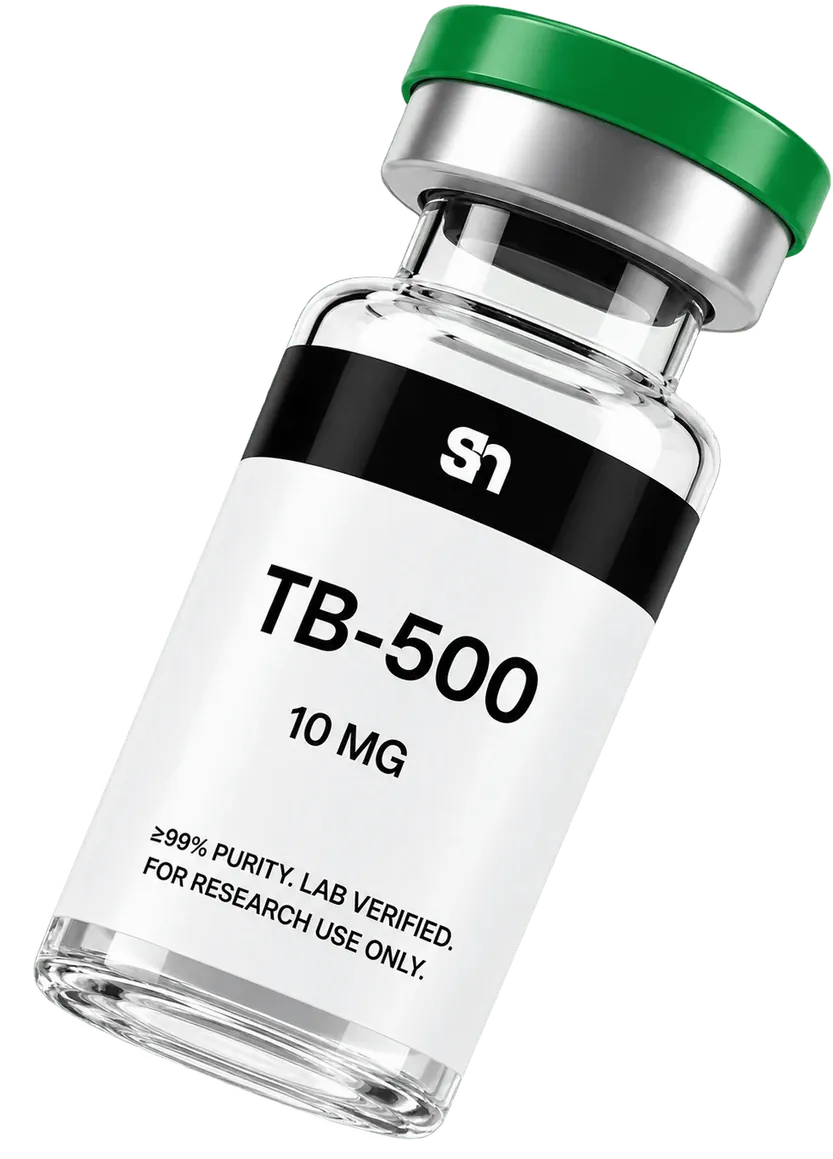
Why the milligram figure on a vial and the net peptide content inside it are two different numbers.
Last updated 28 October 2026 · Written by the SHLabz research team
Net peptide content is the share of a powder’s weight that is actually peptide. The rest is mostly counter-ions and water. So 10 mg of powder holds less than 10 mg of peptide.
This article explains where that gap comes from, how laboratories measure it, and why a high purity figure does not close it. It also covers what the difference means when you work out the concentration of a solution.
Quick answer: Net peptide content is the percentage of a powder’s weight that is peptide rather than counter-ions such as acetate or TFA, and residual water. Laboratories measure it by nitrogen analysis or amino acid analysis. It differs from HPLC purity, which only compares the target peptide with other peptide-related material. Record which figure you use whenever you calculate a concentration.
Gross Weight Versus Net Peptide Content
Gross weight is everything in the vial: the peptide, its salts and any adhered moisture. Net content is the peptidic part alone. Bachem, a large peptide manufacturer, defines net peptide content as the fraction of peptidic material relative to counter-ions and residual water.
The conversion is simple. Net weight equals gross weight multiplied by the net content percentage. For example, Bachem’s own worked case uses a content of 85%, so 1 mg of gross powder gives 0.85 mg of peptide. That figure is an illustration, though, not a typical value. Content varies from sequence to sequence and from batch to batch.
Where the Rest of the Weight Goes
Most synthetic peptides leave purification as salts. During synthesis and purification, acids such as trifluoroacetic acid (TFA) bind to the free amino terminus and to basic side chains. Consequently, the dried powder carries trifluoroacetate or, after an exchange step, acetate alongside the peptide.
A 2020 review in Pharmaceuticals notes that most approved peptide medicines use acetate salts. The authors also note that TFA can interfere with physicochemical characterisation and with cell-based experiments. In other words, the counter-ion is more than dead weight in some research settings.
Water is the second contributor. Lyophilised powder still holds some moisture, and peptides can take up more from the air. Bachem points out that a peptide with many basic residues, especially arginine, tends to show a lower content, because each basic site can carry a counter-ion.
A Worked Net Peptide Content Example
A published drug label shows the counter-ion effect with real numbers. The US prescribing information for bremelanotide describes the drug substance as an acetate salt. It gives a molecular weight of 1025.2 for the free base and states that each peptide carries between one and two acetic acid molecules.
Acetic acid weighs about 60.05 g/mol. With one acetate, the salt weighs about 1085.3, so the peptide makes up roughly 94.5% of it. With two acetates, by contrast, the salt weighs about 1145.3, and the peptide share falls to roughly 89.5%.
That is before any water. Residual moisture lowers the share further, so the net peptide content of a real powder sits below both figures. Notice, too, that this peptide has one arginine and one lysine, both basic. A sequence with more basic residues can carry more counter-ions, which is exactly the pattern Bachem describes.
How Laboratories Measure Content
Because counter-ions and water contain no nitrogen, the nitrogen in a sample comes from the peptide. Therefore elemental analysis for nitrogen gives one route to net content. Amino acid analysis gives another. It breaks the peptide into its amino acids with strong acid, then separates and counts them.
Laboratories can also measure the pieces directly. Karl Fischer titration measures water, while a separate method measures the counter-ion. Each test adds cost and time, and many research-grade certificates leave content out altogether.
Why Purity Is Not Content
HPLC purity compares the target peptide with other peptidic material the detector sees. It ignores salts and water, since they do not show as peptide peaks. As a result, a powder can read 99% pure and still contain far less than its label weight in peptide.
Bachem makes the same point from the other side. Net content and purity are not equivalent, because net content includes peptidic impurities while purity excludes them. Even a very clean peptide can show a low content once salt formation and moisture take their share.
Purity figures also depend on method. When researchers re-tested 98 peptides that came with certificates claiming at least 95% purity, only 43 met that figure under their own conditions. Our guide to HPLC testing covers why method selectivity matters.
Common Misconceptions About Net Peptide Content
A few assumptions cause most of the confusion around this number.
- “99% pure means 99% peptide.” No. Purity ignores salts and water, so the two figures answer different questions.
- “The label weight is the peptide weight.” Not necessarily. A label weight can describe powder, which includes counter-ions and moisture.
- “Counter-ions are an impurity.” Not in the usual sense. They are part of the salt form a peptide leaves purification in.
- “Content is fixed for a compound.” It varies by sequence, salt form, moisture and batch.
- “Low content means poor quality.” Not on its own. A clean peptide with many basic residues can show a modest content.
What the Difference Means in Practice
Consider a simple reconstitution. If you dissolve 10 mg of powder in 2 ml of solvent, the arithmetic gives 5 mg/ml of powder. However, the solution holds less than 5 mg/ml of peptide, by whatever margin the net content implies.
Without a stated net content, nobody can say how large that margin is. That uncertainty matters most when work compares batches, because two batches with the same label weight can differ in content. Accordingly, record the batch number alongside every solution you prepare.
The SHLabz peptide calculator works from the figure you enter. If you hold a net content value for your batch, enter the net weight rather than the gross one. If not, treat the result as a concentration of powder.
Net Peptide Content and SHLabz Certificates
The published SHLabz certificates report a purity and a measured content in milligrams for the vial tested. For example, the BPC-157 certificate for batch BC10/2026-0310 reports 99.764% purity and a content of 9.72 mg for a 10 mg vial. The TB-500 certificate for batch TB10/2026-0310 reports 99.833% and 10.74 mg.
The GHK-Cu certificate for batch SHCU100-082026 goes further. It splits its 86.10 mg content into 75.14 mg of GHK and 10.96 mg of copper. Even so, none of these reports breaks the powder into peptide, counter-ion and water, and none states a net peptide content as a percentage.
So a measured content figure is useful, but it is not a full net content analysis. If a calculation needs that, it needs its own test. Our guide to reading a certificate of analysis explains each line of a report.
Handling and Recording Net Peptide Content
Good records make any content figure usable later. First, write on each label which basis a concentration uses: label weight, measured content or net content. Then add the date and batch number.
Storage follows the general rule. Sealed lyophilised powder is stable at room temperature, dry and out of direct light. Since peptides can take up water from the air, keep vials closed until you need them, and let a cold vial warm before opening. After reconstitution, keep the solution at 2–8°C and do not freeze it.
A Net Peptide Content Checklist
- Read the label weight carefully. First, note whether it describes powder or peptide.
- Check the salt form. Next, look for acetate, TFA or another counter-ion on the documentation.
- Separate purity from content. Treat an HPLC figure as purity only, never as peptide share.
- Look for a measured content. Then note any milligram content figure, and which vial it describes.
- Ask about net content. If your work needs it, ask whether nitrogen or amino acid analysis was run.
- Match the batch. Compare the vial’s batch number with its certificate on arrival.
- State the basis. Write label, measured or net on every concentration you record.
- Keep powder dry. Finally, store sealed vials dry and dark, and solutions at 2–8°C.
Where SHLabz Fits
SHLabz tests through an independent laboratory and publishes certificates by batch on the lab results page. All batch figures are in the open SHLabz Purity Index. Those certificates report purity and a measured content, as set out above. They do not report a net peptide content percentage, so nobody should read a label figure as a net peptide figure.
All compounds come as lyophilised powder in vials. Sealed lyophilised powder is stable at room temperature, dry and out of direct light, and needs 2–8°C after reconstitution. Semax, Selank, KPV, Epithalon and DSIP also come as pre-mixed nasal sprays, for UAE delivery only. Those hold a solution from filling, so they need 2–8°C from arrival. Every UAE order travels with cold-chain delivery, although sealed powder does not require it.
The Short Version
In short, a label weight describes powder, while net peptide content describes the peptide within it. Counter-ions and water make up the difference, and only a dedicated test measures it.
Similarly, purity answers a different question. A high HPLC figure says the peptide is clean, not that the vial holds its full label weight in peptide.
Frequently Asked Questions
Does a 10 mg vial contain 10 mg of peptide? Not necessarily. A label weight can describe the powder, which also contains counter-ions and water. Only a net content test tells you the peptide fraction.
What is a counter-ion? It is a charged molecule, such as trifluoroacetate or acetate, that pairs with charged groups on the peptide. Counter-ions come from synthesis and purification, and they add to the weight of the powder.
Is net content the same as purity? No. Purity compares the target peptide with other peptidic material, while net content compares all peptidic material with salts and water. A sample can score well on one and modestly on the other.
How do laboratories measure net content? The usual routes are nitrogen analysis and amino acid analysis. Some laboratories also measure water by Karl Fischer titration and measure the counter-ion separately.
How much weight can acetate add? It depends on the peptide. For bremelanotide, one or two acetates leave the peptide at roughly 94.5% or 89.5% of the salt’s weight, before any water.
Do SHLabz certificates show net content? Not as a percentage. They report purity and a measured content in milligrams for the tested vial, but they do not break the powder into peptide, counter-ion and water.
Which figure should I use in a calculation? Use the best figure you have, and state it. A net content beats a measured content, which beats the label weight.
References
- What does net peptide content mean? — Bachem, undated FAQ. Definition, nitrogen and amino acid analysis, and the gross-to-net calculation.
- Quality Control of Amino Acids & Peptides: A Guide — Bachem, 2026. Karl Fischer water content, counter-ions, and why content and purity differ.
- The Role of Counter-Ions in Peptides—An Overview — Sikora et al., Pharmaceuticals, 2020. TFA and acetate counter-ions and their effects on characterisation.
- Quality evaluation of synthetic quorum sensing peptides used in R&D — Verbeke et al., Journal of Pharmaceutical Analysis, 2015. Re-testing of 98 peptides against certificate purity claims.
- Vyleesi (bremelanotide injection) prescribing information — US Food and Drug Administration, 2019. Acetate salt form and free-base molecular weight.
Some of these references come from companies working in this field rather than from independent bodies. The underlying chemistry is uncontroversial, though anyone relying on specific figures should confirm them against their own certificates.
Finally, once the label weight makes sense, the catalogue shows every compound and format currently in stock.
This article is provided for general research and educational purposes only. All SHLabz products are sold strictly for laboratory research use and are not intended for human or veterinary consumption, diagnosis, treatment, or prevention of any disease. Nothing in this article constitutes medical advice. Always consult a qualified professional and comply with applicable local regulations regarding the handling and use of research compounds.