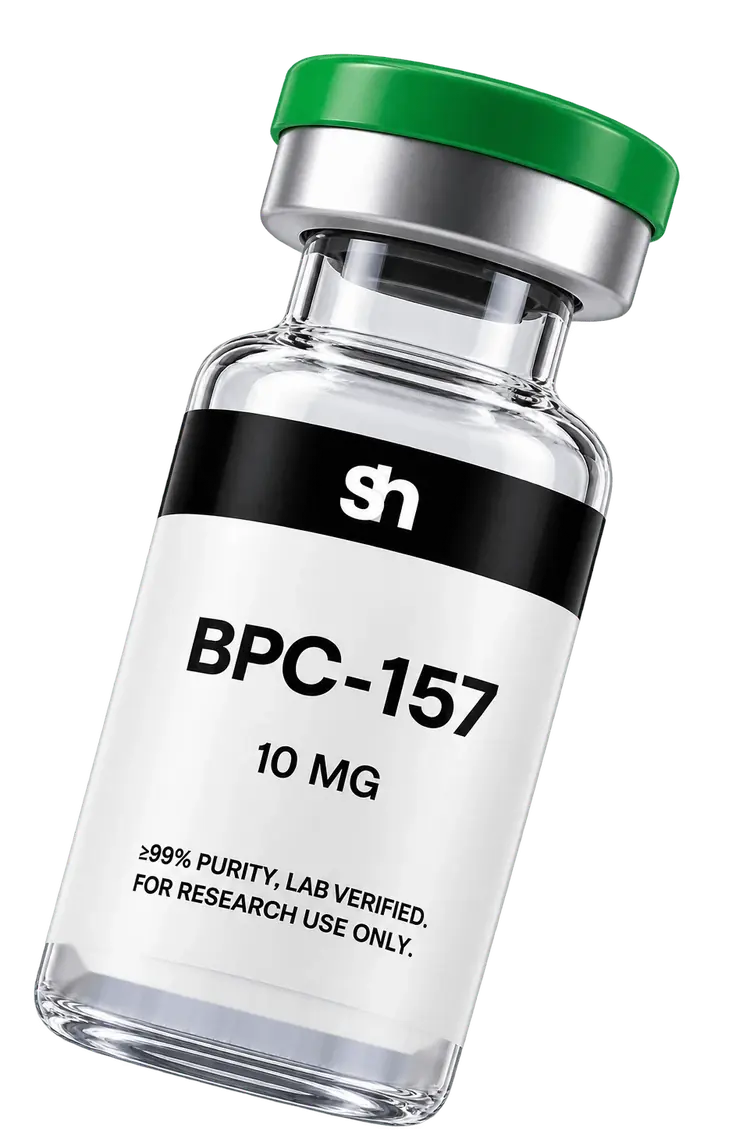

GLOW is a three-peptide research blend: GHK-Cu, BPC-157 and TB-500, freeze-dried together in one vial. This guide explains what each component is, why researchers combine them, and how to source the GLOW blend in the UAE.
Last updated 27 October 2026 · Written by the SHLabz research team
Most research vials hold one compound. A blend, however, changes the arithmetic. Three peptides share one vial, one batch number and, once reconstituted, one solution, so every question about identity, purity and storage now has three parts.
This guide takes the blend apart piece by piece. First comes the regulatory position, then the three components, and then the practical side: certificates, storage, reconstitution and delivery. As with everything in our library, it describes laboratory material and published research, not outcomes in people.
Quick answer: The GLOW blend in the UAE is a 70 mg lyophilised research vial that combines GHK-Cu, BPC-157 and TB-500. None of the three is an approved medicine, so it is laboratory material only. Before ordering, check for a batch-specific certificate, keep the sealed powder dry and dark, refrigerate any solution at 2–8 °C, and expect UAE delivery the same day for orders placed before 12:00 UAE time, or the next day after that.
The GLOW Blend in the UAE at a Glance
- Components. GHK-Cu, BPC-157 and TB-500, a fragment based on thymosin beta-4.
- Format. Freeze-dried powder in a sealed glass vial, listed at 70 mg.
- Main research areas. Skin and connective-tissue models, tissue-repair models and cell migration.
- Storage. Sealed: dry, dark, room temperature. Reconstituted: 2–8 °C.
- UAE delivery. Same day before 12:00 UAE time, next day after; remote areas 1–3 working days. AED 15, free over AED 350.
- GCC delivery. 2–4 working days; AED 60, free over AED 2,500.
GLOW Blend UAE Regulatory Status
None of the three components is an approved medicine in the UAE. In addition, all three appear on the US FDA’s list of bulk drug substances that may present significant risks in compounding, in the section for nominations that were withdrawn. For GHK-Cu, that entry covers injectable routes only.
The UAE position tightened in 2026. In July, the Emirates Drug Establishment acted against 71 sources selling unapproved peptide products and referred 14 influencers over online promotion, as Gulf News reported. The EDE also said that calling a product a “peptide” does not make it an approved medicine. The Dubai Health Authority issued a circular (CIR-2026-00000107, 29 July 2026) on handling peptide products in healthcare facilities.
Meanwhile, neighbouring regulators moved too. In August 2026, Qatar’s Ministry of Public Health issued a circular banning the import, sale, use and promotion of unlicensed peptide preparations. Then, on 30 September 2026, the Saudi Food and Drug Authority announced action against websites and accounts marketing unregistered peptides. Jordan’s Food and Drug Administration (JFDA) warned on 3 September 2026 that it had closed more than 10 online pages and six gyms selling unregistered peptide products (Jordan News, 3 Sep 2026).
So what does a “research use only” label do for the GLOW blend in the UAE? It describes how the seller supplies the material. However, it does not turn the product into a licensed medicine, and Qatar’s circular says such labels give no exemption. Combining three unapproved compounds in one vial does not change the position for any of them. SHLabz therefore supplies the GLOW blend strictly as a laboratory research material.
The Three Components
GHK-Cu
GHK-Cu is the copper complex of the tripeptide glycyl-L-histidyl-L-lysine. A 2018 review by Pickart and Margolina traces its discovery to 1973, when it was isolated from human plasma. Laboratory work has focused on its role in copper transport and on collagen and extracellular-matrix genes in skin models. Our GHK-Cu guide covers it in depth.
BPC-157
BPC-157 is a synthetic 15-amino-acid peptide based on part of a protein found in human gastric juice. A 2025 literature and patent review notes that most published work is preclinical. In other words, it relies heavily on animal and cell models of tissue repair and angiogenesis.
TB-500
TB-500 is a synthetic fragment based on the active region of thymosin beta-4, a 43-residue protein involved in actin regulation and cell migration. A 2012 doping-control study identifies it as the acetylated peptide LKKTETQ, matching positions 17 to 23 of the parent protein. Our BPC-157 and TB-500 guide covers both peptides together.
Why Researchers Use a Blend
In practice, the three peptides touch different, overlapping processes. Research links GHK-Cu to copper-dependent matrix remodelling, BPC-157 to angiogenesis and repair signalling, and TB-500 to cell migration. A pre-mixed vial gives a fixed ratio, one reconstitution step and one certificate to check, rather than three.
The trade-off, though, is flexibility. If your study design needs to vary one component on its own, single vials are the better choice. Similarly, a single-compound control arm needs single vials anyway. Our article on blends versus single compounds explains the decision in more detail.
One common misconception also deserves a line. A blend is not a new molecule. The three peptides sit side by side in the same powder, each with its own structure and mass, so a laboratory should treat the vial as a mixture.
GLOW vs KLOW
KLOW adds a fourth peptide, KPV, to the same three components. KPV is the tripeptide Lys-Pro-Val, which literature has examined in inflammatory signalling research. Researchers who also want KPV in the system choose KLOW, whereas those focused on skin and tissue models without it choose GLOW.
The two also differ on paper, and that matters for any GLOW blend order a UAE laboratory places. KLOW has a published certificate, batch KLOW80/2025-1010, which reports a separate content figure for each of its four components and no single purity figure. GLOW also has a published certificate, so read its figures for your batch on the lab results page before ordering.
Testing a GLOW Blend in the UAE
Normally, a certificate for a single peptide answers one question: is this the compound, and how pure is it? A three-part blend raises that question three times. Consequently, a useful certificate for the GLOW blend in the UAE should name each component and give a result for each.
First, look at identity. Mass spectrometry compares the observed mass of each peptide with its theoretical mass, so a blend report should list three matches. For reference, BPC-157 has a molecular weight of about 1,419.55 Da and the uncomplexed GHK tripeptide about 340.38 g/mol.
Next, read purity with care. HPLC purity is the share of peak area belonging to the target, and in a blend each component has its own peak. One combined percentage would hide which peptide it describes. Likewise, net peptide content differs from powder weight, because lyophilised powder also holds counter-ions such as acetate or TFA and some residual moisture.
Finally, match the batch number on the certificate to the vial, and check that an independent laboratory issued it. Janoshik reports carry a verification link on Janoshik’s own site. Our certificate of analysis guide walks through each field, and every published SHLabz certificate sits on the lab results page: 13 products across 16 batches, all in the open SHLabz Purity Index.
Storing the GLOW Blend in UAE Heat
Sealed lyophilised powder is stable at room temperature, kept dry, sealed and out of direct light. A blend follows the same rule. Cold storage is possible but not required, and repeated cycling between cold and warm risks condensation inside the vial.
Reconstitution, by contrast, changes the picture. Once dissolved, all three peptides share one solution, so the solution is only as stable as its least stable member. Refrigerate it at 2–8 °C, never freeze it, and keep it in its box away from light.
Colour is also worth a note. GHK-Cu gives reconstituted GLOW a faint blue tint, because the copper(II) complex absorbs light at around 605 nm. That colour is normal. Even so, a shade alone tells you nothing about purity, so judge the material by its certificate rather than its hue.
Reconstitution Arithmetic for a Blend
Put simply, concentration is division: milligrams in the vial divided by millilitres of diluent. For example, 70 mg of total powder in 3.5 mL of bacteriostatic water gives 20 mg/mL of total powder. Adding 7 mL instead gives 10 mg/mL.
A blend, however, adds one complication. That figure describes all three peptides together, not any one of them. To state a concentration for each component, you need the per-component amounts from the vial label, and ideally the measured contents from a certificate. Without them, record the total figure only and say so in your notes.
Afterwards, label the vial with the compound, batch number, diluent volume and date. A reconstituted GLOW blend in a UAE lab fridge sits beside other vials, so the label does the work. Our reconstitution guide covers the technique, and SHLabz stocks bacteriostatic water in 3 mL vials.
Delivering the GLOW Blend Across the UAE and GCC
Orders placed before 12:00 UAE time arrive the same day, and orders placed after 12:00 arrive the next day. Processing runs Monday to Friday, excluding UAE public holidays. Remote areas of the UAE take 1–3 working days. Express same-day delivery is available in selected UAE areas, subject to the daily cut-off, so message us first to confirm your area.
Every UAE order, including any GLOW blend, travels with cold-chain delivery. Sealed lyophilised powder does not require cold chain. SHLabz holds the whole range to it anyway, because it removes a variable and the handling difference is small.
Across the GCC, vials arrive in 2–4 working days without cold chain, which is fine for sealed powder. Duties and import requirements are the recipient’s responsibility, and given the 2026 actions above, a GCC laboratory should check its own rules first. Payment options include card, Apple Pay, Tamara in the UAE and Saudi Arabia, crypto, and cash or card on delivery in the UAE only.
A GLOW Blend UAE Checklist
Before you order the GLOW blend in the UAE, or any three-peptide blend, work through these points:
- Batch-specific certificate. First, ask for a report that covers the blend itself, not just each raw ingredient.
- Named independent laboratory. Second, check who ran the test and whether the report can be verified on the lab’s own site.
- Identity for every component. Next, look for mass spectrometry results for all three peptides.
- Batch match. The batch number on the certificate should match the vial in your hand.
- Honest storage claims. Sealed powder does not need a freezer; anyone saying it must be frozen is wrong.
- Clear delivery terms. Look for stated delivery windows, cut-off times and a returns policy.
- Labelled vials. Avoid unlabelled “stealth” vials, because they break the chain of custody.
- No human-use marketing. Finally, treat usage advice or outcome claims as a documentation gap.
The Short Version
In short, GLOW combines GHK-Cu, BPC-157 and TB-500 in one 70 mg freeze-dried vial for research into skin, tissue-repair and cell-migration models. None of the three is an approved medicine, and 2026 brought regulatory action in the UAE, Qatar and Saudi Arabia.
Meanwhile, the practical rules stay simple. Store sealed vials dry and dark at room temperature, refrigerate any solution at 2–8 °C, and ask for a certificate that reports all three components for your batch.
Frequently Asked Questions
What is in the GLOW blend? GHK-Cu, BPC-157 and TB-500, freeze-dried together in one 70 mg vial. All three arrive as one lyophilised powder.
Is the GLOW blend legal in the UAE? None of its components is an approved medicine in the UAE, and SHLabz supplies it for laboratory research only. Anyone with a procurement question that carries legal consequences should confirm the current position independently.
Why is reconstituted GLOW blue? The copper(II) complex in GHK-Cu absorbs orange-red light, so the solution looks faintly blue. That is normal and says nothing about purity.
Does GLOW have a certificate? Yes. SHLabz publishes it with its other certificates, including the KLOW blend’s, on the lab results page.
What is the difference between GLOW and KLOW? KLOW adds a fourth peptide, KPV, to the same three components. GLOW leaves KPV out.
Can I order GLOW to Saudi Arabia? Sealed vials ship to the GCC in 2–4 working days. Duties and import requirements are the recipient’s responsibility, and the SFDA acted against unregistered peptide sellers in September 2026.
Does the sealed vial need a fridge? No. Sealed lyophilised powder is stable at room temperature when dry and out of direct light. After reconstitution, though, keep the solution at 2–8 °C.
References
- Regenerative and Protective Actions of the GHK-Cu Peptide in the Light of the New Gene Data — Pickart and Margolina, International Journal of Molecular Sciences, 2018. GHK-Cu’s identity, its 1973 discovery and the models studied.
- Multifunctionality and Possible Medical Application of the BPC 157 Peptide — Literature and Patent Review — Józwiak et al., Pharmaceuticals, 2025. BPC-157’s origin, sequence and evidence base.
- Doping control analysis of TB-500, a synthetic version of an active region of thymosin β4 — Ho et al., Journal of Chromatography A, 2012. The LKKTETQ sequence and its actin-binding region.
- Certain Bulk Drug Substances for Use in Compounding — US Food and Drug Administration, 2026. Entries for GHK-Cu, BPC-157 and TB-500.
- UAE crackdown: 71 sources and 14 influencers face action — Gulf News, July 2026. The EDE’s enforcement action and its statement on peptides.
These references describe published research. They say nothing about what any compound does for anybody, and nothing here should read as a claim that it does.
Finally, if you would rather weigh GLOW against its single-compound vials, the GLOW Blend page sits in the catalogue alongside each of them.
This article is provided for general research and educational purposes only. All SHLabz products are sold strictly for laboratory research use and are not intended for human or veterinary consumption, diagnosis, treatment, or prevention of any disease. Nothing in this article constitutes medical advice. Always consult a qualified professional and comply with applicable local regulations regarding the handling and use of research compounds.